.svg)
How Upkeep went from no tracking to 184 leads a month
About the Company

Upkeep Building Maintenance
Dubai-based smart-lock and smart-device contractor. Its Google Ads account was rebuilt from the tracking layer up across an eight-month engagement.
Industry:
Smart-Lock Contractor
Service / Product:
Google Ads management. Account rebuild + ongoing optimisation.
Market:
UAE
Length of Partnership:
November 2023 to July 2024 (8 months, concluded)
Upkeep is a Dubai smart-device contractor. Smart locks, smart-home integrations, and related installations are the main commercial line. A broader building-maintenance arm runs alongside.
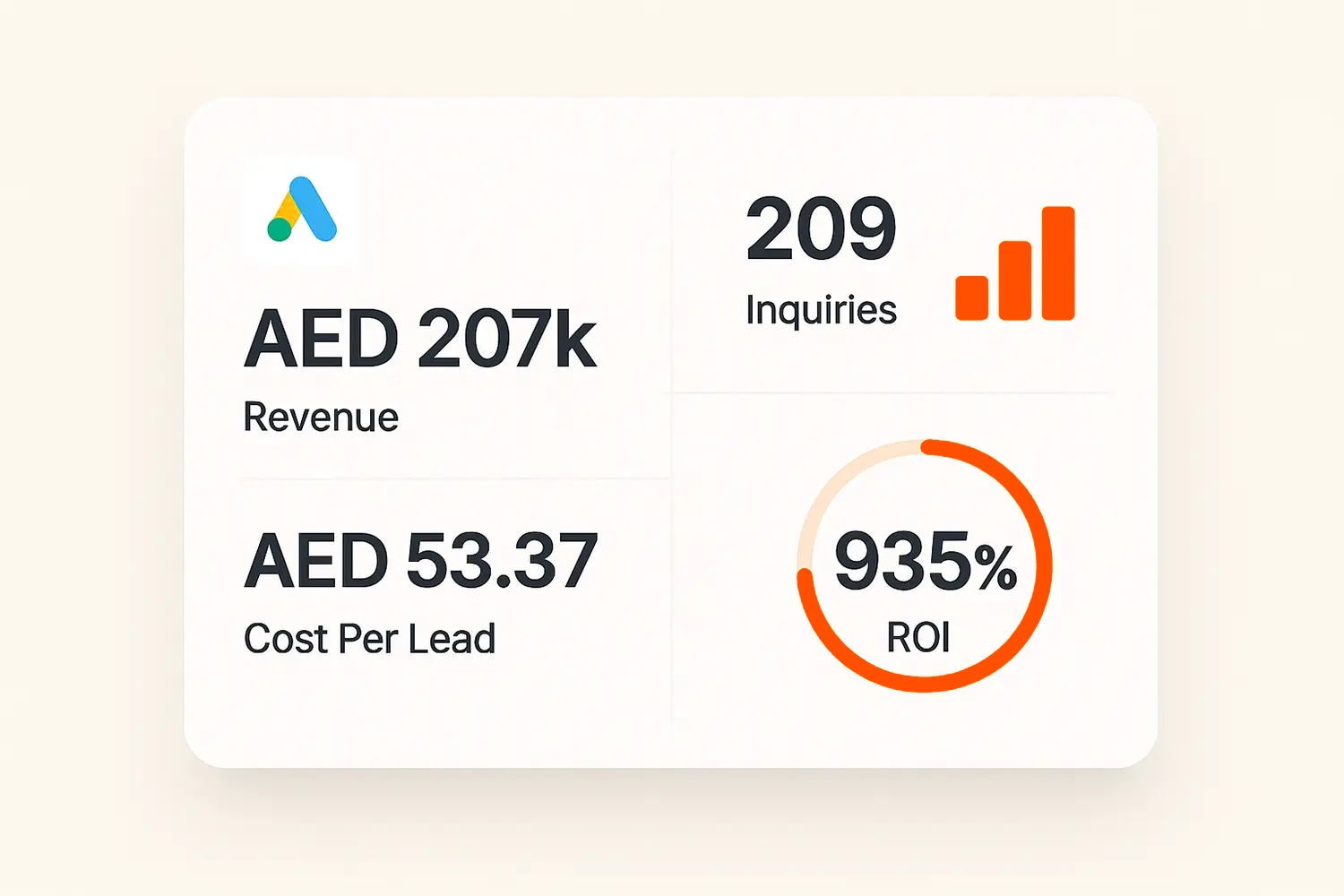
The engagement started in November 2023. By the final month the account produced 184 monthly leads at AED 28 each. The 8-month engagement returned a 5.15× ROAS, based on client-reported AOV and close rate. It closed in July 2024 after eight months.
The numbers came out of a tracking-first rebuild plus product-by-product segmentation. Cheap clicks turned into commercial buyers. The case below is how that played out.
The Challenge
Pre-engagement, average cost-per-click was AED 0.59. That number is the whole story.
Cheap traffic is the mechanism by which accounts get 0 qualified leads, not a sign the account is performing well. Bids that low mean the account is matching low-intent garbage clicks. Researchers, students, job-seekers, anyone who clicks on a smart-lock ad without buying a smart lock. A serious commercial buyer in Dubai costs more to reach than that. The CPC is the diagnostic.
The conversion rate could not say the same thing because there was no conversion rate. Conversion tracking was not configured. The client could not see how many leads they were getting. Smart Bidding was running, but with no signal feeding it, optimising on whatever clicks the algorithm could afford. All products lived in a single ad group, no segmentation, no match-type strategy. The account currency was set to USD on a Dubai-local business advertising in Dubai.
By the time we wrapped, average cost-per-click was AED 6.68. The account was finally buying commercial buyers, not garbage clicks. The CPC stopped being the diagnostic. The conversion rate took over.
The Strategy
The fix was three moves, run in order. Each maps to one of the four pillars of the way we run B2B Google Ads accounts.
1. Install conversion tracking. This is move one on every inherited account. It was move one on Upkeep.
“Google is like a blind man, and the guide dog is the data we feed it. Without the right data, Google loses its sense of direction and can’t find its way to our target customer.”
That is the literal mechanism we walked into. Smart Bidding had been turned on for months, with no conversion signal feeding it. The algorithm had no destination to walk toward. AED 0.59 cost-per-click was the algorithm wandering. Once our conversion-tracking service was in place, the algorithm had a map. Form-fills, phone calls, and WhatsApp button clicks all started reporting back. Smart Bidding had something real to optimise toward, and it began to walk a different street. AED 6.68 cost-per-click in the final month is the same algorithm, walking with a guide dog. This is Pillar 4 of our system. Smart Bidding’s reliance on a real conversion signal is documented in Google Ads Help on Smart Bidding signals.
2. Build dedicated landing pages, volume-weighted by product. Upkeep sold several products under one roof, and each product had a different commercial intent behind its searches. We built dedicated landing pages product by product, starting with the highest-demand product and working down. Each page was custom-built, included in the retainer for the lifetime of the engagement. The shared homepage was no longer the destination for paid traffic. (Pillar 3.)
3. Segment products into separate ad groups. With the landing pages built, the campaigns followed. One product per ad group. That structure lets match types, keywords, and negatives get tuned product by product. Negatives that protect the smart-lock product can hurt the broader maintenance product. Separate ad groups is what makes per-product tuning possible. This is Pillar 2 of our Google Ads management service.
The work compounded over eight months. The numbers are below.
The Result
Here is the trajectory.
- Monthly spend: AED 2,217 (pre-engagement) to AED 5,153 (final month).
- Conversions: 0, not tracked, to 184.
- Conversion rate: not measurable to 23.9%.
- Cost per conversion: not measurable to AED 28.00.
- Average CPC: AED 0.59 to AED 6.68.
Across the eight months, 926 commercial leads at an average AED 40.70 cost each. The final month finished at AED 28 cost per lead. That is below the eight-month average. The account was still improving at the point we wrapped.
The client reported an AOV of AED 1,400 and a close rate of 15%. The 926 leads work out to about AED 194,500 in attributed revenue on AED 37,800 of ad spend. A 5.15x return on ad spend across the eight months. The final month alone produced 184 leads. At the same AOV and close rate, that is AED 38,640 in attributed revenue. Spend was AED 5,153. A 7.5x monthly ROAS. We publish the AOV and close rate as client-reported. The math should be checkable in line. Google’s documentation on offline conversion imports covers the mechanism. It lets Smart Bidding train on a qualified-lead signal once the CRM side is set up.
Book a free 30-minute Google Ads audit →
What we couldn’t fix on this engagement
WhatsApp tracking gap. We could see WhatsApp button clicks, not whether the user actually messaged. The gap was real, and we didn’t close it on Upkeep. The same pattern recurred across enough engagements that our team built a separate tool to close it, waconversiontracking.com. That is a different conversation. The point here is we did not have the fix in 2024.
USD/AED currency configuration. The account was set to USD despite Upkeep being a Dubai-local business advertising in Dubai. We inherited it that way and chose not to break the historical reporting continuity by switching mid-engagement. Inherited misconfigurations of this shape, wrong currency, wrong timezone, mislabelled goals, are common in incoming accounts. The fix is fast. The priority is usually the bigger structural problems first.
Final-month-still-improving disclosure. AED 28 cost per lead in the final month was below the eight-month average of AED 40.70. The cost curve was still bending down at the point we wrapped. Read the numbers as a trajectory, not a steady state.
Browse other engagements for more proof patterns across verticals.

Lead Ember is an amazing google ads agency. Their team consists of professionals and hardest working, most creative and impressive people. They know their stuff, inside and out and have constantly sent amazing result to all of us. I suggest their services.
Lead Ember is an amazing google ads agency. Their team consists of professionals and hardest working, most creative and impressive people. They know their stuff, inside and out and have constantly sent amazing result to all of us. I suggest their services.
Key Takeaways for Construction & Contracting
The playbook is not smart-lock specific. The same three moves recover other inherited B2B accounts.
The dedicated-LP-per-product pattern ran on the Trisoft Acoustic Panel case study too. Trisoft is an acoustic-panel manufacturer in a different vertical. Different industry, same volume-weighted LP cadence.
The conversion-tracking-first sequencing ran on the Vigilant Kitchens case study, a fit-out engagement. The shape of the account was different. The fix order was the same.
The Pillar 4 mechanic that started Upkeep’s recovery is the spine of the Batic Law Firm case study too. Batic is a Saudi legal-services engagement. Qualified-lead signal flowed back through offline conversion uploads from the client’s CRM. Same mechanic, different vertical.
Smart-lock contracting falls under our broader construction and contracting coverage, one of industries we work with across the broader B2B portfolio.
The fit isn’t universal. We turn down prospects when the unit economics don’t work. The math has to favour the client before we sign a retainer, and three conditions decide that.
The first is no commercial-intent search demand on UAE Google for the client’s product or service. We validate this in 30 seconds on Google’s Keyword Planner during the audit. It is a fast no when it is a no. Without commercial-intent volume, paid search has nothing to bid on. The unit-economics math fails before campaigns launch.
The second is no CRM lead-qualification discipline. Smart Bidding on a volume signal beats Smart Bidding on noise. Smart Bidding on a qualified-lead signal flowing back from the CRM beats both. Without that signal flowing back, the account plateaus at the volume optimisation. The math works for a while, then bumps a ceiling we cannot push past from the paid-ads layer.
The third is a client wanting Google Ads to validate an unproven offer. Paid search scales an offer that already closes deals through other channels. It does not validate one that has not. If the offer has not closed yet, the unit-economics math is a guess until it does.
We’d rather tell you the math doesn’t favour you than take your retainer and fail against it.
Related Case Studies

Heading


Thirty minutes with our founder. How many people in the UAE search for what you sell, what it costs to turn that into inquiries, and what it would return. If it isn't worth it, we tell you.
.svg)
Lead Ember is a B2B Google Ads agency in Dubai that generates qualified inquiries for contracting, manufacturing and service-based businesses.


Business Park, Dubai South, Dubai, UAE